Match the conditions.
Keep actors, task cases, reset rules, trial budgets, and interaction limits consistent while changing the memory method.
 VRL-Bench
A UNIFIED SIMULATOR FOR AGENT MEMORY SYSTEMS
Does experience make your agent better?
VRL-Bench lets you find out through fair trial-and-error simulation.
TRIAL-AND-ERROR REPLAY
Step through its actions alongside the memory it received and the trial and action budgets.
RECORDED RUN
Actual saved pages, actions, and memory. Playback makes no model calls.
CONTROLLED MEMORY EVALUATION
Across three models on MiniWoB and WebShop, leading memory methods improve success in some settings and reduce it in others. Fair trial budgets make these differences visible.
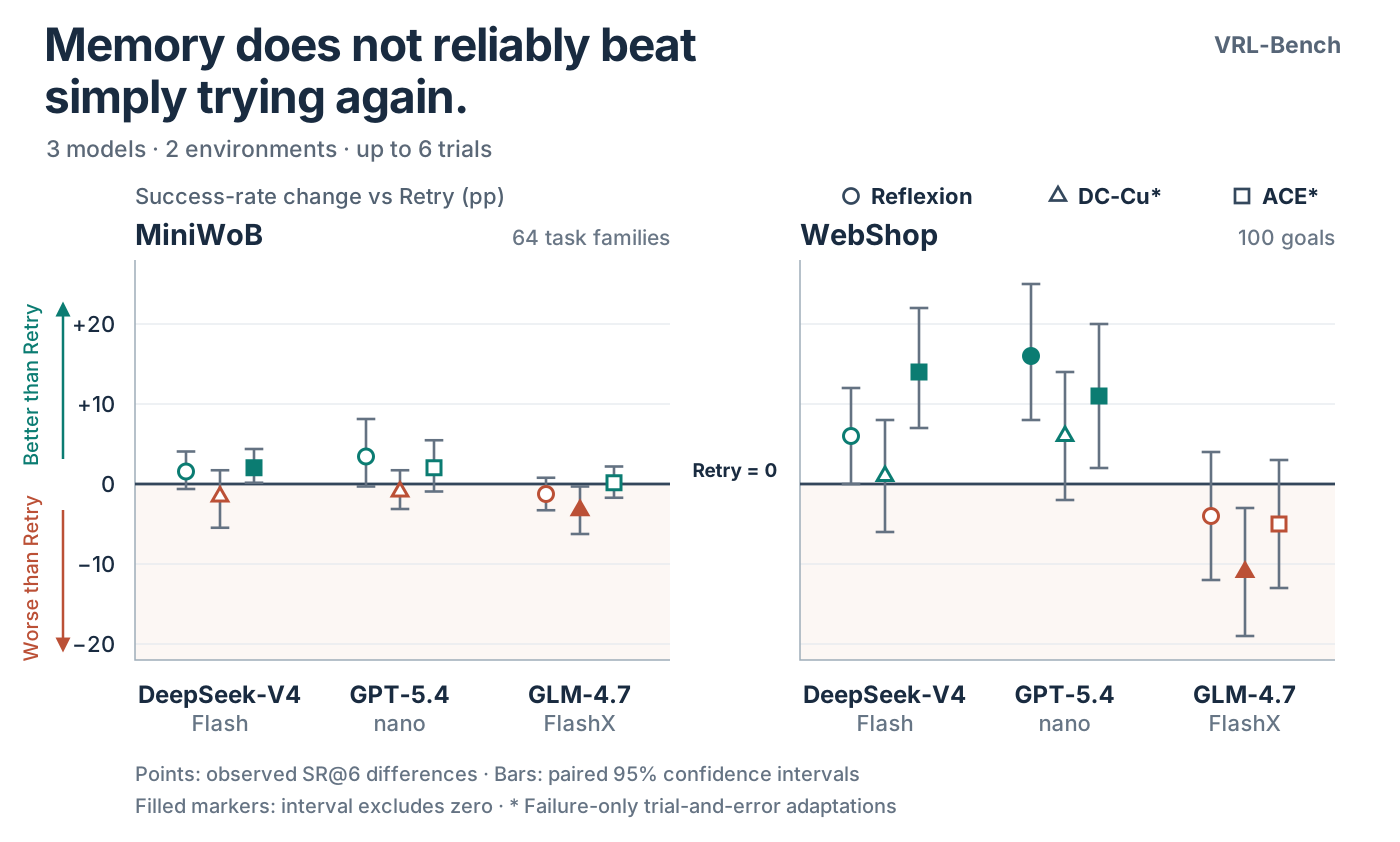
Read the findings and experimental settings
EXPLORATION & EXPLOITATION
Retained experience can guide an agent—and displace useful exploration. Reflection-exposure experiments revealed this tension in verbal reinforcement learning.
Control experience exposure with the Replay gate, or study an integrated scheduler such as VEX².
Explore the exposure experiments ↗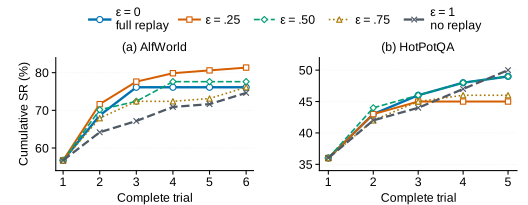
A FAIR PLACE TO STUDY AGENT MEMORY
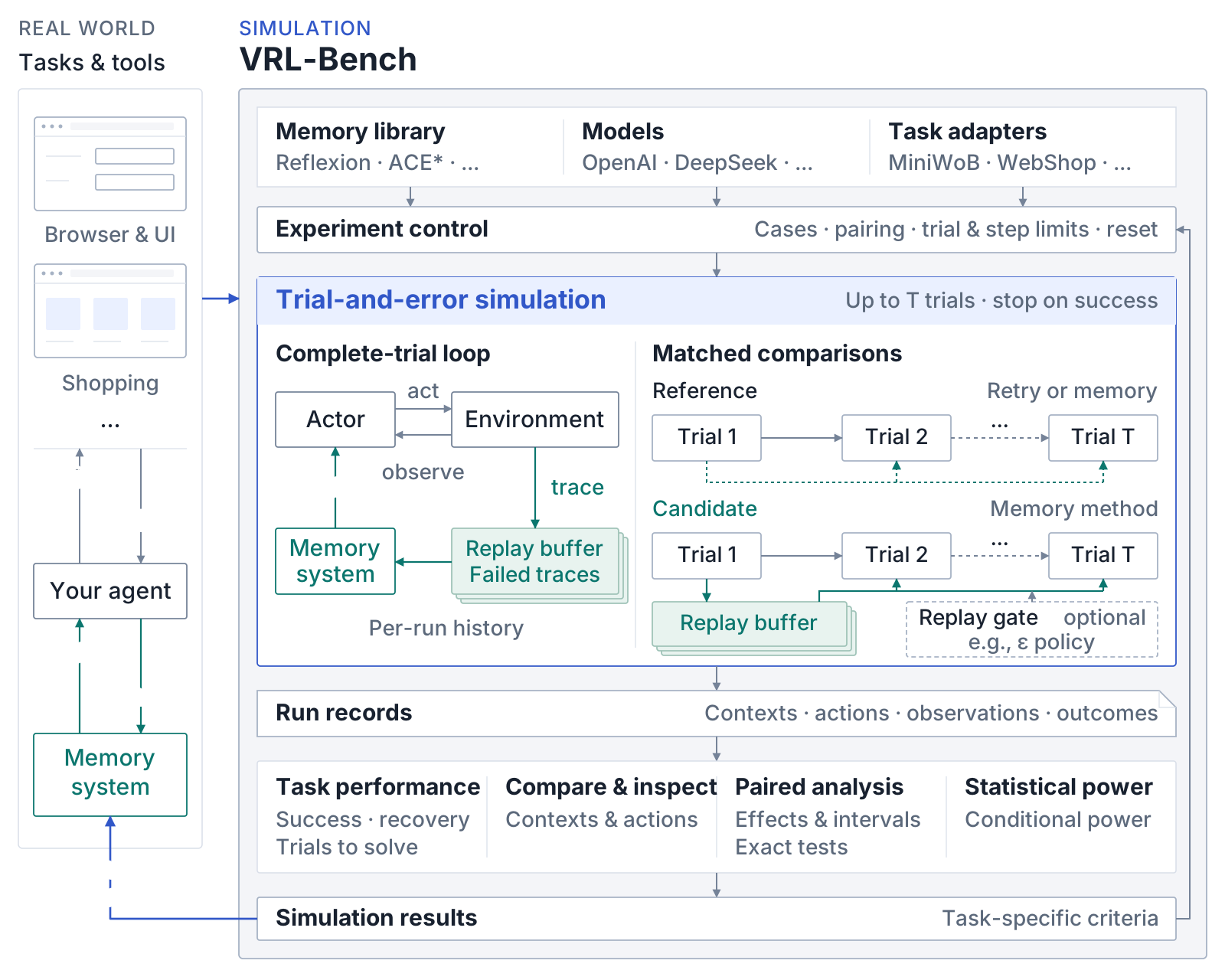
In verbal reinforcement learning, an agent turns interaction feedback into language-based experience for later attempts. VRL-Bench provides a common simulation workflow for developing and comparing these memory systems.
Keep actors, task cases, reset rules, trial budgets, and interaction limits consistent while changing the memory method.
Inspect what reaches the next trial, what the agent does, and how it uses its remaining opportunities.
Measure success, recovery, and trials to solve. Use paired intervals, exact tests, and conditional power to interpret comparisons.
BUILD ON A COMMON FOUNDATION
Use a reference method, connect your own implementation, and improve it from task-level feedback. Compare a new version with the previous one under the same conditions.
* Adapted to failure-only trial and error. Memory-free Retry is included as a common exploration baseline.
Run memory-free Retry on your tasks.
Evaluate the complete implementation.
Compare each candidate with its predecessor.
Start with a real MiniWoB browser task. The example configurations save page snapshots for replay; use the same workflow with other prepared environments.
Get startedvrlbench simulate --config examples/configs/miniwob_retry.json
vrlbench simulate --config examples/configs/miniwob_reflexion.json
vrlbench replay runs/miniwob_retry runs/miniwob_reflexion
vrlbench compare runs/miniwob_retry runs/miniwob_reflexionSimulations call your configured model. Saved-run replay makes no model calls.